Pease Pottage 01403 275 276
Petersfield 01730 777 350
Maidstone 01795 843 866
Cullompton 01884 211 788

How to Choose the Right Non Woven Geotextile in 2026?

Choosing the right non woven geotextile in 2026 starts with the ground, not the product catalogue. A fabric used beneath a gravel access road faces different demands from one wrapped around a drainage trench. Soil gradation, water flow, installation damage, and long-term loading all matter. A roll that looks tough can still clog or stretch if its properties do not suit the site.

Grand View Research estimated the global geotextiles market at about USD 8.2 billion in 2023 and projected continued growth through 2030. That figure signals a large, active sector; it does not prove that any particular fabric will perform well. Robert M. Koerner, a leading geosynthetics specialist, described geosynthetics as “the fastest growing segment of the plastics industry.” Growth brings more options. It also makes careful comparison essential.

For a practical selection, examine apparent opening size, permittivity, tensile strength, puncture resistance, and survivability during placement. Match test values to the soil and design conditions, and check the relevant ASTM or ISO test method. Ask for current datasheets and independent test reports. Then confirm that the product can be installed without tearing or excessive overlap. Small details matter. A clogged fabric is not a minor paperwork problem; it can undermine drainage and maintenance plans. And, honestly, a tidy datasheet may still leave questions about field conditions. This guide explains how to compare specifications, identify trade-offs, and choose with evidence rather than habit.
How to Choose the Right Non Woven Geotextile in 2026?

Define the Function First: Filtration, Separation, Drainage, or Protection

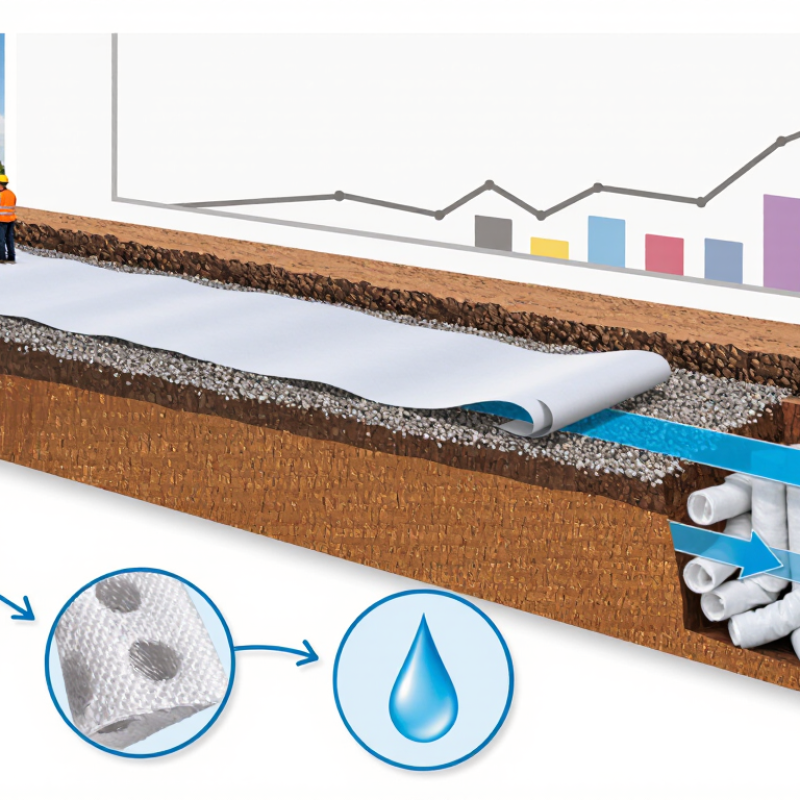
Start with the job the fabric must do, not its weight. For filtration, water should pass while soil particles stay in place. Match the geotextile’s opening size and permeability to the soil gradation and expected flow. A very tight fabric can clog; an overly open one may let fines escape. Small differences matter.

Separation is different. Under a gravel road, nonwoven geotextile helps keep aggregate from mixing with soft subgrade during repeated wheel loads. Check tensile strength, puncture resistance, and installation damage, not thickness alone. Drainage needs careful wording: the fabric can transmit water through its plane, but it is not automatically a high-capacity drain. Pair it with a drainage layer and check flow under pressure.

Protection means cushioning a vulnerable surface, such as a waterproofing membrane, from nearby stone or backfill. Look at puncture resistance and the contact conditions, including sharp edges and placement methods. One specification rarely answers everything. That sounds obvious. Yet projects sometimes select by weight alone, then discover the chosen fabric solves the wrong problem. Review the site soil, loading, water path, and installation plan before settling on a product type.

How to Choose the Right Non Woven Geotextile in 2026? — Define the Function First: Filtration, Separation, Drainage, or Protection
Primary Function What the Geotextile Does Typical Applications Key Properties to Check Selection Guidance Common Selection Mistake
Filtration Allows water to pass through while limiting the movement of soil particles. Subsurface drains, drainage trenches, retaining-wall drainage, and erosion-control systems. Apparent opening size (AOS), permittivity, soil gradation, and clogging resistance. AOS is commonly measured using ASTM D4751; permittivity using ASTM D4491. Match the fabric’s opening size and hydraulic properties to the soil and expected water flow. Consider soil particle-size distribution and site conditions. Choosing by fabric weight alone, or selecting an opening size without considering the soil that must be retained.
Separation Reduces intermixing of adjacent soil or aggregate layers while allowing water to pass through. Roads, unpaved access roads, rail subgrades, and working platforms over weak soils. Tensile strength, puncture resistance, survivability during installation, and suitability for the subgrade and aggregate. Grab tensile strength is commonly measured using ASTM D4632; static puncture using ASTM D6241. Assess subgrade strength, aggregate size, construction traffic, and installation conditions. Specify strength requirements based on the project design and relevant standards. Assuming that any geotextile will prevent mixing, regardless of installation damage or the condition of the subgrade.
Drainage Provides a pathway for water to move within the plane of the fabric or through a geocomposite drainage system. Behind retaining walls, under slabs, in landfills, and in roadway edge-drain systems. In-plane flow capacity (transmissivity), compressive behavior, long-term flow under load, and filtration compatibility with adjacent soil. In-plane flow is commonly evaluated using ASTM D4716. Determine the required flow rate, drainage length, hydraulic gradient, confining pressure, and expected service conditions. A geotextile may serve as the filter around a separate drainage core. Using cross-plane permeability as a substitute for checking in-plane drainage capacity under the project’s expected load.
Protection Cushions and helps reduce localized damage to an adjacent membrane or other sensitive material. Geomembrane liners, waterproofing membranes, and other systems where a protective cushion layer is specified. Mass per unit area, thickness, puncture resistance, compressibility, and compatibility with the protected material. Mass per unit area is commonly measured using ASTM D5261. Consider the membrane type, subgrade and cover materials, contact pressure, and installation process. Use the project’s specified protection and puncture criteria. Selecting a product based only on thickness or mass without checking puncture resistance and the conditions on both sides of the fabric.

Practical note: A nonwoven geotextile can perform more than one function, but the design should identify the primary function first. Final properties and test requirements should be set by the project engineer using site-specific soil, hydraulic, loading, and installation conditions.
Match AOS to Soil Gradation: Common Specifications Span About 0.075–0.30 mm

How to Choose the Right Non Woven Geotextile in 2026?

AOS, or apparent opening size, describes the approximate openings in a nonwoven geotextile. It helps indicate whether soil particles can pass through or remain behind the fabric. Common specifications span about 0.075–0.30 mm, but this is a selection range, not a universal rule. Match the opening size to the soil’s gradation, especially its finer particles. A product that retains too much soil may clog; one with openings that are too large may allow excessive soil loss. That balance matters.

Tips: Review a sieve analysis before choosing. Compare AOS with the project specification and the fabric’s published test data. Check permeability, too. If soil data is incomplete, pause and request testing rather than guessing.

Field conditions can complicate a tidy specification. Mixed soils, changing groundwater, and installation damage all affect filter performance. For example, silty backfill beside a drainage trench may need a different AOS from clean, coarse sand. Ask a geotechnical professional to assess retention and clogging risks for the actual soil and flow conditions. AOS alone cannot predict long-term performance, and a neat number can create false confidence. Verify the applicable test method and specification before ordering.

Compare Permittivity in s⁻¹ Using ASTM D4491, Then Check Soil Retention

Permittivity describes how readily water passes through a geotextile across its thickness. ASTM D4491 reports it in reciprocal seconds (s⁻¹). Compare products tested under the same method and conditions; a higher value may indicate greater flow capacity, but it is not a quality score by itself. Check the stated test head and specimen details. Small differences can affect a close comparison. Read the data carefully.

Then check soil retention. The geotextile must allow water through while limiting soil movement, so consider the soil’s particle-size distribution alongside the fabric’s apparent opening size. A product with high permittivity may still be unsuitable if its openings let fine particles pass. One detail is easy to miss: silty soil can behave differently from clean sand, especially when water flow carries particles toward the fabric.

For a roadside drain, compare test data with the project soil and expected flow conditions, not just a catalog figure. Consider clogging risk, installation damage, and any pressure from surrounding soil. A short laboratory test cannot reproduce every field condition. I would verify the selection against site-specific soil data where possible; it is tempting to rely on one headline number, but that can leave important questions unanswered.

Rate Strength with ASTM D4632 Grab and D4833 Puncture Tests in Newtons

Choosing a nonwoven geotextile means matching measured strength to the worksite, not picking the largest number. ASTM D4632 measures grab tensile strength: a fabric specimen is clamped and pulled until it fails. The result, reported in newtons, helps indicate resistance to pulling during handling and installation. Check whether the reported value is minimum, typical, or average; those terms are not interchangeable.

ASTM D4833 measures puncture resistance by pushing a specified probe through a specimen. Its result is also expressed in newtons. This test can help compare fabrics exposed to angular aggregate, protruding roots, or rough subgrades.

Picture a gravel lift being spread over fabric: a higher puncture value may offer more resistance, but it cannot guarantee the fabric will survive every stone or installation method.

Read both values alongside the project conditions. Confirm the test method, units, and product thickness before comparing data sheets. A fabric with strong grab results may still be vulnerable to puncture, and the reverse can also happen. Small details matter. Soil support, stone size, equipment traffic, and seam layout all affect performance. Test numbers are useful, but they are not the whole story. When risk is high, ask for comparable test reports and consider a project-specific trial; that extra step can feel cautious, perhaps even inconvenient, but it may expose assumptions before installation.

Assess UV Durability by Retained Strength After 500 Hours of Exposure

When comparing nonwoven geotextiles in 2026, ask for retained tensile strength after 500 hours of UV exposure—not just a “UV resistant” label. ASTM D4355/D4355M describes xenon-arc exposure followed by tensile-strength testing. The result is typically reported as a percentage of the unexposed strength. For example, a fabric measuring 1,000 N/m before exposure and 700 N/m afterward retains 70%. That is a useful comparison, not a universal pass mark.

Check that competing test reports use the same exposure method, specimen conditioning, and tensile-test procedure. Otherwise, percentages can look comparable while describing different tests. FHWA’s Geosynthetic Design and Construction Guidelines (NHI-07-092) treats sunlight exposure as a durability consideration and advises protecting geosynthetics from prolonged exposure. In practice, a roll left uncovered beside a bright, open worksite faces a different risk from one installed and covered promptly.

Look closely at the report date and product construction, too. UV performance can vary with polymer, additives, and fabric structure; a result from one specification should not automatically be applied to another. One caveat: 500 hours is a screening point, not a direct prediction of years in service. Ask for the test report, verify the retained-strength figure, and consider the project’s actual exposure conditions. One detail is easy to miss: installation delays can matter.

How to Choose the Right Nonwoven Geotextile in 2026?

Compare tensile strength retained after 500 hours of UV exposure.

Retained strength (%) = exposed tensile strength ÷ unexposed tensile strength × 100. The values shown are illustrative examples, not product test results or a universal acceptance threshold. For selection, compare specimens tested using the same method and exposure conditions, and verify results with the supplier’s test report.