Finding a dependable China-based supplier for grass protection mats takes more than comparing prices. Buyers need products that protect turf while supporting people, vehicles, or equipment under defined conditions. A mat that performs well on a garden path may not suit a busy event site or construction access route. Intended use matters.
Chinese manufacturers offer a wide range of materials, sizes, surface patterns, and load ratings. Product details deserve close attention. Check mat thickness, panel weight, connection design, drainage openings, edge finish, and resistance to ultraviolet exposure. Ask how load capacity was tested, and request clear product specifications rather than relying on broad claims. A glossy brochure is not proof. Samples can reveal surface grip, flexibility, and how easily panels connect. They cannot, on their own, confirm long-term performance.
This guide explains how global buyers can assess suppliers, compare quotations, and reduce avoidable procurement risks. It also considers factory experience, quality-control procedures, customization, packaging, and communication during production. Request relevant test reports and confirm that documents match the exact model being offered. Clarify minimum order quantities, lead times, spare-panel availability, and shipping terms before placing an order. Small details matter.
No single supplier is right for every project. A lower quotation may reflect different materials, testing, or service, so comparisons should use the same requirements. Even experienced buyers can overlook a specification or assume two mats are equivalent. That is worth questioning. The aim is not to praise every supplier, but to help buyers make a practical, evidence-based choice.
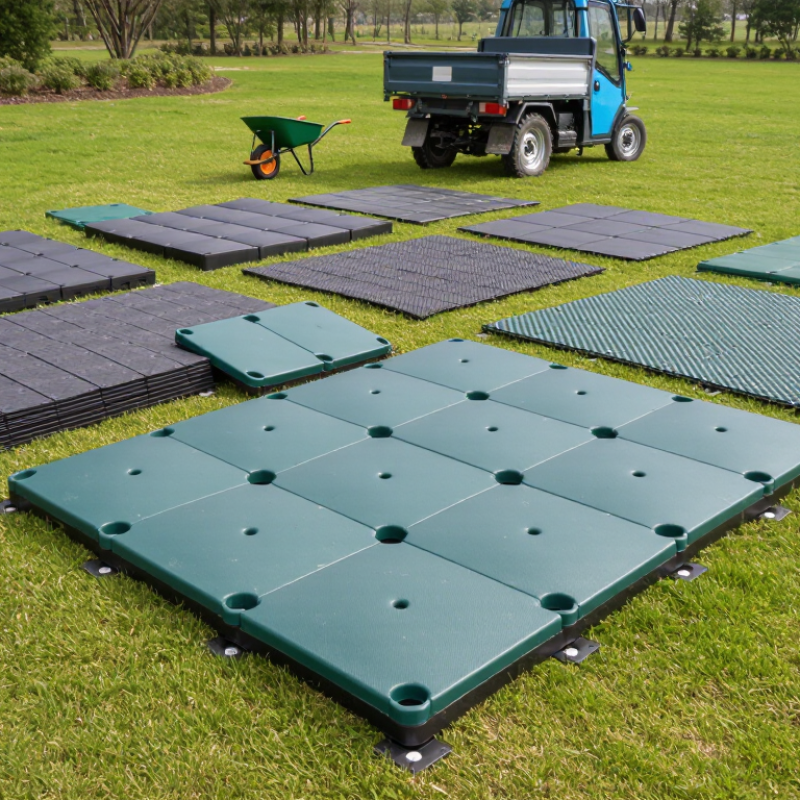
Grass protection mats are temporary panels placed over turf to reduce damage from foot traffic, carts, or light vehicles. They create a firmer route across lawns, parks, and event grounds. Many have textured surfaces for grip and openings that allow some air and water to reach the grass. Designs differ, so the intended load matters.
Under pressure, a mat spreads weight across a wider area instead of letting shoes or tires press deeply into one spot. Interlocking edges can help keep panels aligned, while the underside may grip the ground. On a damp lawn, this can limit ruts and torn roots. It is not magic. Soft, saturated soil can still shift beneath a heavily loaded mat.
Installation considerations Before installation, inspect the ground and check the product’s load guidance, thickness, and connection system. Lay mats on reasonably even turf, close gaps, and remove trapped stones that could bruise the grass. For a busy site, test a small section and check it after a few passes. I would not assume every grass-safe mat leaves no marks; shade, duration, and soil moisture all matter.
Grass protection mats are commonly made from high-density polyethylene or polypropylene. These polymers resist moisture and repeated outdoor use, while their flexibility helps mats sit against uneven ground. Some products include recycled plastic. Ask for the recycled-content percentage and material test data, since quality can vary between batches.
Manufacturing shapes how a mat performs. Injection molding can create firm panels with raised ribs, drainage openings, and interlocking edges. Extrusion can produce continuous mesh that is cut to length. UV stabilizers may slow sun-related brittleness, but performance depends on formulation and exposure. It matters. Inspect the underside, too: sharp edges or uneven ribs may press into turf. A supplier’s sample is useful, but one piece cannot prove batch consistency. Ask about thickness checks, load testing, and production records. Not always glamorous, but these details help buyers compare mats on practical evidence rather than appearance alone.
| Material | Common Manufacturing Method | Typical Product Characteristics | Grass Protection Considerations | Potential Trade-Offs | What Buyers Should Verify |
|---|---|---|---|---|---|
| Virgin high-density polyethylene (HDPE) | Commonly injection molded into interlocking panels; some designs use other thermoplastic forming processes. | Lightweight for its strength, moisture resistant, and suited to reusable modular panels. Panel stiffness depends on design, thickness, and rib structure. | Openings or a textured underside can help maintain airflow and drainage, while a broad load-bearing surface can distribute traffic. | Performance varies substantially with panel geometry and resin formulation. Plastic panels may become less flexible in cold conditions. | Request material and product specifications, stated load-test conditions, connection details, temperature guidance, and cleaning instructions. |
| Recycled polyethylene (often HDPE) | Usually processed as a thermoplastic by injection molding or another suitable molding process. Recycled feedstock may be blended with other polyethylene. | Can use post-consumer or post-industrial plastic feedstock. Color and appearance may vary between production batches. | Can be suitable for temporary access or event use when panel design, drainage, and ground conditions are appropriate. | Feedstock composition and consistency can affect impact behavior, stiffness, and appearance; “recycled” alone does not establish performance. | Ask for recycled-content documentation, batch quality controls, dimensional tolerances, and test results for the finished panel. |
| Polypropylene (PP) | Typically injection molded for rigid modular panels; the process and tooling are selected according to panel design and production volume. | A relatively lightweight thermoplastic with good moisture resistance. Rigidity and impact behavior depend on formulation and construction. | May be used for temporary ground-cover systems; drainage openings and underside design should suit the intended surface and duration of use. | Low-temperature impact performance and long-term outdoor behavior should be assessed for the specific grade and product design. | Confirm the resin type, operating-temperature guidance, UV-stabilization details if claimed, and relevant finished-product test methods. |
| Recycled rubber or rubber crumb composite | Often compression molded from rubber granules and binder; exact formulation and curing process vary by product. | Generally flexible and textured, with a comparatively resilient feel. Products may be supplied as tiles or mats rather than rigid interlocking vehicle panels. | Can provide a cushioning surface for pedestrian areas, but suitability depends on drainage, surface stability, and the amount and type of traffic. | May be heavier and less convenient to handle than lightweight plastic panels. Binder, porosity, and exposure conditions influence durability. | Check composition, slip performance where relevant, drainage behavior, odor guidance, dimensions, and intended traffic category. |
Material and process descriptions are general industry guidance, not a supplier ranking. Actual load capacity and service life depend on the finished design, installation, ground conditions, temperature, and use; compare products using test reports with clearly stated methods and conditions.
Grass protection mats serve two practical roles: they shield turf during landscaping work and create temporary routes for people, wheelbarrows, and light vehicles. On lawns, parks, and event grounds, distribute loads across the mat surface to limit rutting and direct damage to grass. The National Association of Landscape Professionals’ 2024 industry snapshot puts U.S. landscaping services at about $153.6 billion in 2023, showing the scale of work where ground protection can matter. Small detail, big difference: clear loose stones before laying mats, or they may press into the turf.
For temporary access, use mats to cross soft ground near planting areas, maintenance zones, or outdoor work sites. USDA Natural Resources Conservation Service soil-health guidance explains that compaction reduces soil pore space and can restrict water movement. That matters after rain. Check soil moisture, expected loads, and route length before choosing mat thickness and connection style; a product suitable for foot traffic may not support a loaded vehicle. Mats are not a cure-all, either. Poorly joined panels can shift, and leaving them down too long may still stress grass. Careful placement and timely removal are easy to overlook.
Examples of common applications for grass protection mats. Bars count the example use cases listed in each category; they do not represent market share or usage frequency.
Landscaping examples include event lawn protection, maintenance access, garden paths, tree-root-zone protection, and landscape installation. Temporary-access examples include pedestrian routes, utility maintenance, emergency routes, event service access, and vehicle access where the mat’s load rating and ground conditions are suitable.
Evaluating Chinese grass protection mat suppliers takes more than comparing quoted prices. Ask for a technical data sheet showing mat dimensions, thickness, material, connection design, and rated load. Request the test method behind each load figure; numbers without conditions are hard to compare. Ask whether the rating applies to a single mat or a connected surface. Small detail. It matters when trucks turn or equipment rests on the same area for hours.
Request production samples and check the edges, surface grip, and fit between connected mats. Test them on damp grass and uneven ground, not only on a clean warehouse floor. A neat sample does not prove every batch will match, so ask how the supplier checks thickness and appearance during production. Request recent inspection records and clear answers about defects, replacement parts, packaging, and lead times. If a supplier avoids specific questions, pause. Still, no checklist removes every risk; real site conditions can expose weaknesses that a short sample test misses. Compare written specifications with what arrives, and keep that gap in mind.
For global buyers sourcing grass protection mats from China, delivery planning starts before production. Confirm roll width, thickness, surface structure, UV resistance, and rated ground pressure. These details affect installation and replacement costs. Request test results for the actual material batch, not just a generic product sheet. Small details matter.
Packaging needs equal scrutiny. Confirm pallet dimensions, gross weight, roll labels, moisture protection, and container-loading photos before dispatch. UNCTAD’s Review of Maritime Transport 2024 reports that maritime trade grew 2.4% in 2023, reaching 12.3 billion tonnes. This is not a mat-specific forecast, but it shows the scale of global shipping and why buyers need realistic transit buffers. Check twice. Agree on inspection timing, document versions, and rework responsibilities before paying a deposit.
A sample may feel firm on a clean warehouse floor yet behave differently on wet soil. This is where sourcing plans can overlook actual site conditions. Ask for tests on the intended soil type and under the expected vehicle load, with recorded results. If a trial is not possible, state that limitation in the purchase specification. Optimism is not a delivery control. Keep shipping terms, packing lists, invoices, and delivery addresses aligned. Allow for measurement variation, but keep acceptance criteria clear.