
Retail floor space is costly, and crowded aisles can make even good products easy to miss. Wall-Mounted Display Racks use vertical surfaces to present merchandise while keeping more floor area open. Picture a clear aisle, visible product labels, and frequently purchased items arranged within easy reach. These details can improve how shoppers navigate a store, though results depend on layout, product type, and installation.
POPAI’s 2014 Shopper Engagement Study reported that 82% of purchase decisions were made in-store. That finding concerns in-store decisions broadly; it does not prove that wall-mounted racks alone increase sales. Still, it highlights why product visibility deserves attention. Retail anthropologist Paco Underhill is often associated with the succinct maxim, “Retail is detail.” A well-positioned rack puts that idea into practice through careful spacing, readable signage, and thoughtful product placement.
There are trade-offs. Poorly mounted fixtures can look cluttered, block sightlines, or place products beyond comfortable reach. A rack that works for lightweight packaged goods may not suit heavier items. Measure the wall, check the load rating, and test the arrangement with real shoppers. Small changes matter. So does honest evaluation: track browsing patterns and sales before claiming a display has worked.
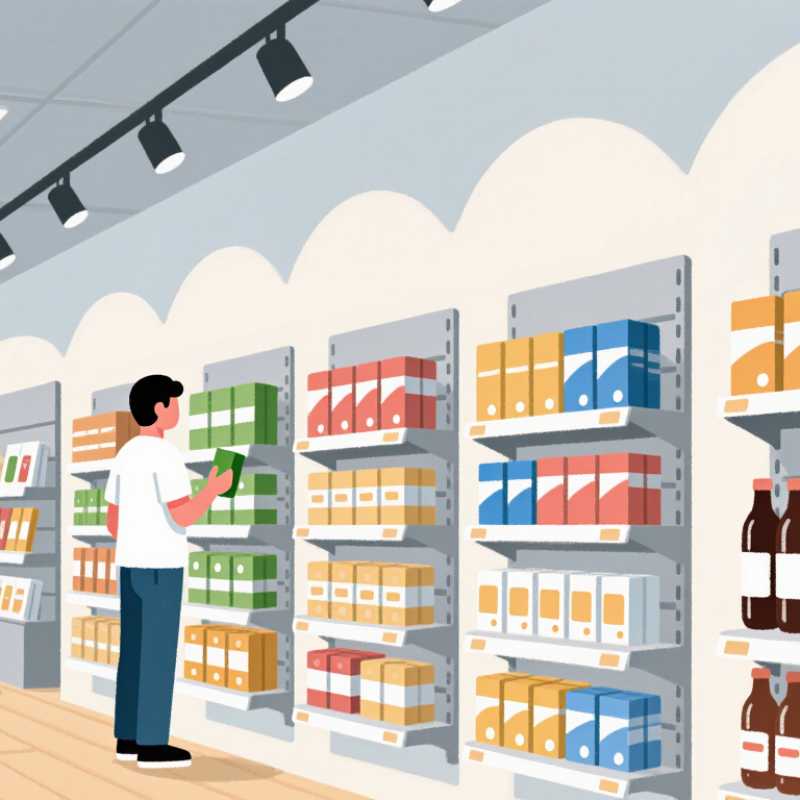
A wall-mounted display rack is a shelving or rail system fixed directly to a store wall. It holds products, signs, hooks, or small baskets without using floor-standing fixtures. Common designs use vertical standards with adjustable brackets, while simpler racks have fixed shelves or pegs. The exact parts depend on the products and the wall.
Here’s how it works. The rack transfers the weight of displayed goods through its brackets and fasteners into the wall structure. Installers need to check the wall material and choose suitable anchors; drywall, masonry, and timber-backed walls do not support loads in the same way. A shelf filled with glass jars, for example, puts more strain on its supports than a row of lightweight packets. Small details matter.
Once securely mounted, adjustable rails let staff move shelves or hooks as inventory changes. This can make product groups easier to see and keep narrow aisles clear. Still, a rack is not automatically space-saving if products protrude too far or obscure nearby signs. Measure the wall, consider how customers reach each item, and follow the fixture’s stated load limits. The wall itself is easy to overlook.
Wall-mounted display racks attach to a suitable wall or wall-mounted rail system to present merchandise vertically. The specifications below are general planning references; actual dimensions and load limits vary by product, wall construction, and installation method.
| Display Rack Type | How It Works | Typical Configuration | Suitable Merchandise | Retail Use and Practical Considerations |
|---|---|---|---|---|
| Slatwall shelves and hooks | Accessories fit into horizontal grooves in a slatwall panel, allowing shelves, hooks, and brackets to be repositioned. | Common shelf depths are approximately 6–16 in (15–41 cm); verify accessory compatibility with the panel. | Packaged goods, accessories, small household items, and folded apparel. | Useful for changing assortments. Confirm that the panel and its wall fixings are appropriate for the merchandise load. |
| Gridwall panels and attachments | Wire panels accept compatible hooks, baskets, and shelves that can be moved between grid openings. | Panels are available in multiple sizes; attachment depth and spacing depend on the selected accessories. | Hanging accessories, tools, packaged merchandise, and lightweight baskets. | The open grid keeps the wall visually light. Use compatible attachments and secure the panel according to installation instructions. |
| Wall standards with adjustable brackets | Vertical standards are fixed to the wall; brackets slot into the standards and support adjustable shelves. | Shelf depth is selected for the products and aisle layout; bracket spacing and system compatibility vary. | Books, boxed goods, folded garments, and other products suited to flat shelving. | Shelf heights can be changed as product sizes change. Load limits depend on the standards, brackets, shelves, anchors, and wall structure. |
| Wall-mounted pegboard | Hooks and small shelves engage with regularly spaced holes in a rigid panel. | Hole spacing and accessory fit vary by panel system; check dimensions before purchasing attachments. | Small tools, craft supplies, accessories, and lightweight packaged products. | Provides a flexible arrangement for individually hung products. Distribute items evenly and observe the panel’s stated capacity. |
| Wall-mounted hanging rail | A fixed rail supports compatible arms, hooks, or hangers for suspended products. | Rail length, arm projection, and spacing are selected for the wall area and merchandise. | Clothing, bags, packaged items, and products designed to hang. | Keeps hanging items off the floor and can make products easy to browse. Leave adequate clearance for customers and adjacent fixtures. |
| Fixed wall shelf | A shelf is secured directly to the wall using brackets or a concealed support system. | Shelf width, depth, material, and support spacing depend on the intended use and installation conditions. | Decorative items, folded products, and selected display pieces. | Offers a clean, simple presentation but is less adjustable than track-based systems. Locate suitable structural support when installing. |
Planning note: Wall-mounted racks can free floor space and use vertical wall area, but they must be installed with fixings suitable for the wall type and expected load. Follow the rack manufacturer’s installation instructions and stated load limits.
