Pease Pottage 01403 275 276
Petersfield 01730 777 350
Maidstone 01795 843 866
Cullompton 01884 211 788

China Top 10 Lead Radial Capacitor Manufacturers

Lead Radial Capacitor selection can look simple: check capacitance, voltage, dimensions, and temperature rating. Yet a small mismatch can affect ripple handling, service life, or board fit. In a power supply, the part may sit beside a warm transformer, with its leads bent into tight PCB holes. Those details matter.

EMC engineer Henry W. Ott is widely associated with this practical reminder: “The best way to solve an EMC problem is to not have it in the first place.” His point is not specific to capacitors, but it suits component selection: thoughtful design can prevent avoidable problems later. For a Lead Radial Capacitor, that means checking ripple current, equivalent series resistance, endurance rating, lead spacing, and operating temperature—not capacitance alone.

China’s manufacturers offer products across many voltage and capacitance ranges. Their catalogs can look similar. The differences often emerge in test data, production consistency, documentation, and support for custom requirements. This guide introduces ten manufacturers and considers the information buyers should verify before shortlisting them. A ranking is only a starting point. It cannot replace reviewing current datasheets, confirming traceability, and testing samples in the intended circuit. Some company details may change, too; that is easy to overlook. Reliable sourcing takes more than a polished product page.
China Top 10 Lead Radial Capacitor Manufacturers

Overview of Lead Radial Capacitors and Their Role in Electronics

Lead radial capacitors remain useful because their two wire leads pass through a circuit board, making them simple to mount and replace. Their cylindrical bodies often sit upright beside power supplies, audio circuits, and control boards. Inside, an electrolyte and thin metal foils store charge and smooth voltage changes. They are not glamorous. They do steady work.

Grand View Research’s 2024 capacitor market report estimated the global market at about US$22.1 billion in 2023, with growth projected through 2030. This figure covers many capacitor types, not lead radial parts alone, but it reflects broad demand for energy storage and filtering components. In practical designs, engineers check capacitance, voltage rating, temperature range, ripple current, and expected service life. A poorly matched part can heat up or lose capacity over time. A little less obvious: physical spacing matters too, especially when neighboring components run hot.

Tips: Check the polarity marks before soldering. Leave room for airflow, and compare the rated lifetime with the device’s expected operating temperature. Data sheets help, though real-world conditions can be messier than a neat bench test.

China’s Lead Radial Capacitor Manufacturing Landscape

China’s lead radial capacitor manufacturing landscape includes component makers, material suppliers, testing laboratories, and assembly partners. Production commonly involves winding, impregnation, sealing, lead forming, and electrical testing. At the factory level, small process differences can affect capacitance, leakage current, and service life. Temperature-controlled storage and careful handling also matter, especially for moisture-sensitive materials. These details matter. A consistent process is more useful than impressive equipment alone.

Manufacturers may serve consumer electronics, industrial controls, lighting, and power supply applications. Their capabilities vary by product type, production scale, and quality systems. Buyers should compare specifications, sample results, and inspection records rather than relying on broad claims. Ask how capacitance, dissipation factor, and endurance are checked across production batches. A useful review also considers traceability and how production changes are documented. Not every supplier will provide the same depth of evidence. That can make evaluation slower. It is worth checking. Small gaps in records may reveal where further questions are needed. Real-world performance still depends on operating temperature, circuit design, and installation conditions.

Criteria for Selecting the Top Ten Manufacturers

Selecting ten lead radial capacitor manufacturers requires more than comparing catalogue size or quoted price. Mordor Intelligence’s 2024 capacitor market analysis estimated the global market at about US$24 billion in 2024, with projected growth to US$32.6 billion by 2029. This broad market figure does not isolate radial components, but it signals a crowded supply base. Buyers should compare capacitance, voltage, tolerance, ESR, ripple-current ratings, and operating temperature against the intended circuit.

Evidence matters. Request current datasheets, lot traceability, and test records for endurance, leakage current, and temperature performance. Check whether published values match the actual series and case size, not merely a family-level overview. IEC 60384-4 provides relevant requirements for fixed aluminium electrolytic capacitors, while automotive projects may also require application-specific qualification evidence. Paper claims are easy. Reproducible test conditions are harder.

Manufacturing consistency deserves close attention: inspect lead spacing, sleeve condition, polarity marking, and packaging that prevents bent leads during shipment. Ask how process changes are controlled and how suppliers handle failed batches. A useful comparison scores technical fit, documented quality, delivery stability, and engineering response time. Still, a ranking can miss small but important gaps; public reports rarely separate radial lead products from the wider capacitor market. I would treat any top-ten list as a shortlist, then verify samples under real operating conditions.

Profiles of Ten Leading Chinese Manufacturers

Profiles of ten leading Chinese manufacturers are most useful when they show how each factory handles real production needs. Compare radial capacitor ranges by capacitance, rated voltage, temperature rating, and lead spacing. A 5 mm pitch may suit a compact control board, while thicker leads can help with larger components. These details matter more than broad claims about capacity.

Look for differences in production focus. One manufacturer may offer a wide range of standard values; another may support custom lead forming or tighter dimensional tolerances. Check whether datasheets state test conditions, ripple current, and expected operating life. Ask how incoming materials and finished batches are inspected. Clear answers make comparisons more reliable. Catalog figures can look neat; factory reality is less tidy. Verify samples before committing to a large order, and remember that one supplier’s strengths may not fit every design.

Tips: Request a current datasheet and a sample from the same product series. Compare body size, lead alignment, and markings against your board layout.

China Top 10 Lead Radial Capacitor Manufacturers - Profiles of Ten Leading Chinese Manufacturers
Profile Area Data Dimension Industry Reference or Information to Verify Why It Matters
01 Product construction Confirm whether the product is a radial-leaded aluminum electrolytic capacitor, a conductive-polymer type, or another capacitor technology. Construction affects capacitance, ESR, ripple-current capability, service life, and suitable applications.
02 Capacitance range Check the manufacturer’s series datasheets for available capacitance values; the range is series-specific and should not be assumed from a general catalog description. Confirms that the required capacitance is available in the needed voltage, size, and temperature combination.
03 Rated voltage Verify the rated DC voltage for each part number and observe the specified operating conditions and derating guidance. Voltage rating is a part-level specification; a catalog’s overall voltage span does not apply to every capacitance or case size.
04 Capacitance tolerance Read the tolerance stated on the specific datasheet. A ±20% tolerance is common for many aluminum electrolytic series, but it is not universal. Helps determine whether the component meets circuit limits at initial measurement and across operating conditions.
05 Operating temperature Check the series’ minimum and maximum operating temperatures, along with any temperature-dependent electrical limits. Temperature ratings and performance vary among series and can affect lifetime and electrical behavior.
06 Endurance and useful life Compare the specified endurance test conditions, including temperature, applied voltage, and test duration. Use the datasheet’s life-estimation guidance where provided. Endurance figures are test-condition dependent and should not be compared without checking the conditions.
07 Ripple current and ESR Review rated ripple current, its frequency and temperature correction factors, and ESR at the stated measurement conditions. These parameters are important for heating, power-supply filtering, and performance under AC ripple loads.
08 Leakage current Check the maximum leakage-current limit and the measurement time and conditions specified in the product datasheet. Leakage limits and test methods can differ by series, voltage, and manufacturer.
09 Dimensions and lead spacing Verify body diameter, body height, lead diameter, lead spacing, and any snap-in or forming requirements against the individual part drawing. Mechanical fit and correct PCB-hole spacing must be confirmed for the selected part number.
10 Compliance and traceability Request current declarations and lot documentation as applicable, and confirm any required environmental, quality, or automotive qualification for the exact product. Compliance and qualification are product- and market-specific; verify documentation rather than inferring status from a supplier’s general claims.

Note: Company names, brand data, and unverified company rankings are intentionally omitted. The references above are general evaluation guidance, not specifications attributed to individual manufacturers; use the current datasheet for each exact part number.

Product Ranges, Applications, and Quality Standards

Radial lead capacitors cover several product families, including aluminum electrolytic, ceramic, and film types. Their values range from small capacitances for signal filtering to larger values for power smoothing. Voltage rating, temperature range, package diameter, and lead spacing all affect fit. Measure the board before choosing. A catalogue is only a starting point.

These components appear in power supplies, lighting drivers, audio circuits, household appliances, and industrial control boards. Aluminum electrolytic parts often provide high capacitance in compact spaces, while ceramic parts suit many bypass and filtering tasks. Film types can be useful where stable characteristics matter. The best choice depends on ripple current, operating temperature, expected service life, and available board area. One weakness in many comparisons is treating capacitance as the only deciding factor.

Quality checks should match the capacitor type and intended use. Buyers can review capacitance tolerance, leakage current, dissipation factor, endurance data, and solderability results. Applicable IEC 60384 specifications may provide a useful reference, but requirements differ by product family. Ask manufacturers for traceable test records and clear storage guidance. Details matter. Even reliable data cannot replace testing in the actual circuit, especially when heat or vibration is present.

China Top 10 Lead Radial Capacitor Manufacturers

Product Ranges, Applications, and Quality Standards

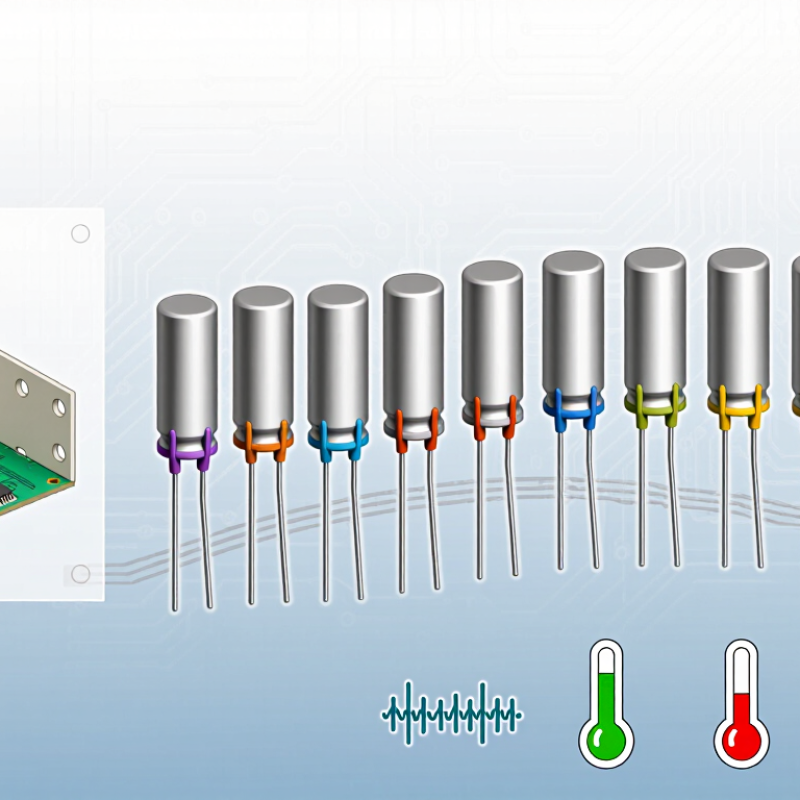
Product range: Radial-leaded capacitors are offered in different capacitance, voltage, case-size, and lead-spacing options. The chart shows commonly encountered lead-spacing choices; availability varies by capacitor type and series.

Applications: Depending on the dielectric and electrical ratings, radial capacitors are used in power-supply filtering, decoupling, timing, signal coupling, and EMI suppression.

Quality standards: IEC 60384-1 covers generic requirements for fixed capacitors. IEC 60384-4 applies to aluminum electrolytic capacitors. AEC-Q200 is a stress-test qualification standard for passive components used in automotive applications; applicability depends on the product and customer requirements.