Choosing the right drainage channel in 2026 requires more than comparing prices or visual finishes. A channel beside a garage door faces different demands from one serving a busy airport apron. Load class, hydraulic capacity, grate security, corrosion resistance, installation depth, and maintenance access must work together. One missed detail can leave water pooling beside a threshold.
The need is growing. The UNDRR Global Assessment Report 2022 identified floods as 44% of recorded disasters between 2000 and 2019. The IPCC Sixth Assessment Report also reports that heavy precipitation events are increasing in many regions. These findings make surface-water planning a practical safety issue, not merely a landscaping choice. A suitable drainage channel should capture runoff quickly, guide it safely, and remain serviceable after repeated storms.
Stormwater researcher Thomas R. Schueler offered a useful principle: “Manage runoff near its source.” That advice supports choosing channel placement before selecting materials. It also challenges a common assumption. The largest channel is not always the best one. A narrow polymer-concrete channel may suit a pedestrian courtyard, while a deeper reinforced system may be necessary near delivery vehicles.
There is no universal specification.
In this guide, we will compare channel materials, load ratings, outlet arrangements, grate designs, and lifecycle costs. We will also question optimistic product claims. A drainage channel can look durable in a catalogue, yet fail when bedding, slope, or cleaning access is poorly designed. Reliable selection combines published standards, manufacturer data, site experience, and honest review after installation.
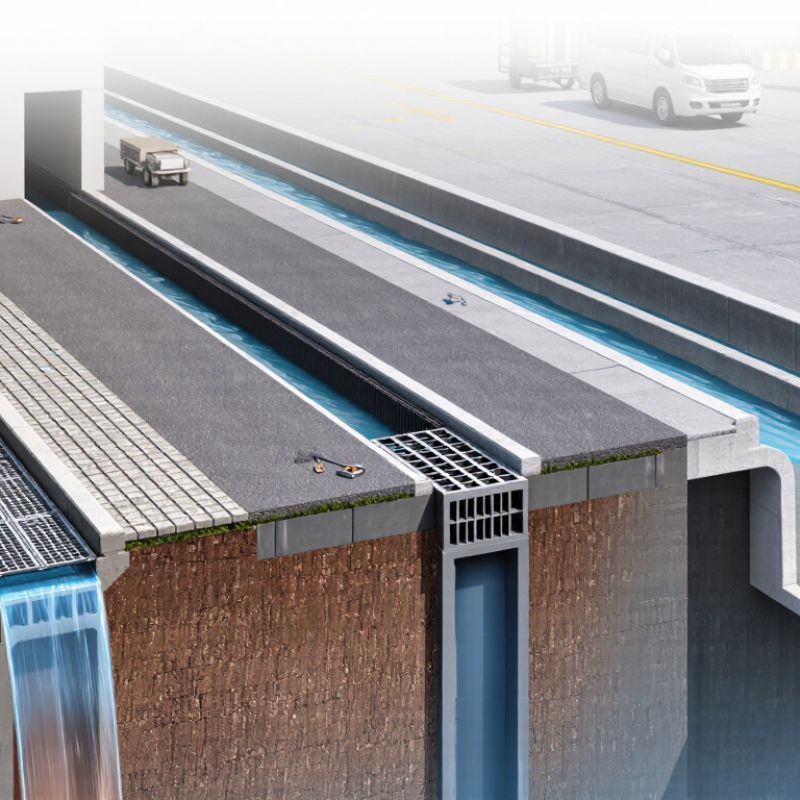
Drainage channels collect surface water and guide it toward a safe outlet. They protect walkways, foundations, roads, and planting areas from ponding and erosion. The need is growing. The UN World Water Development Report 2023 projects urban water demand could increase by 80% by 2050. Poor drainage will become more expensive to ignore.
A linear trench channel suits driveways, patios, factory floors, and long edges. A point drain works better where water gathers in one small area. Slot drains offer a narrow, cleaner surface opening, but they can be harder to inspect.
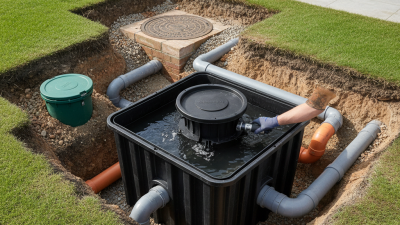
Main components include the channel body, grate, edge frame, outlet, end cap, and sediment basket. Some systems also need inspection boxes and removable access covers.
Choose by water volume, slope, debris, and traffic load. EN 1433 load classes help match grates with pedestrian zones, parking areas, or heavy vehicles. Material also matters. Polymer concrete handles demanding loads, while polymer channels are lighter during installation. Stainless or galvanized grates resist different exposure conditions. The UN World Water Development Report 2024 states that agriculture represents about 70% of global freshwater withdrawals, making reliable water control increasingly important. Still, a strong channel can fail if the outlet is undersized. I have seen clean installations clog within months because maintenance access was overlooked. Check local rainfall records, calculate flow, and leave room for sediment removal.
How to Choose the Right Drainage Channel in 2026?
A reliable channel begins with the site, not a catalogue. Walk the area during rain, if possible. Mark low points, paved surfaces, soil types, slopes, and likely debris paths. Measure it first. NOAA Atlas 14 provides local precipitation-frequency data for short and long storm durations. Use the relevant 5-, 15-, and 60-minute rainfall depths, rather than relying on annual averages. A channel beside a loading yard faces different risks from one beside a garden path. Vehicle loads, freeze-thaw cycles, sediment, and pedestrian safety all affect the selection.
Estimate the contributing catchment and peak discharge using rainfall intensity, surface area, and runoff coefficients. FHWA’s HEC-22 Urban Drainage Design Manual provides established methods for this assessment. Then check channel capacity with the Manning equation, including slope, roughness, and hydraulic depth. Leave practical freeboard. Blocked grates are common. Small errors matter. A system designed only for average flow may surcharge during a short cloudburst. Climate allowances should follow current local guidance, because future rainfall projections vary by region.
The outlet requires equal attention. Confirm where water will go, how fast it may leave, and whether erosion protection is needed. Inspect access points before installation; maintenance crews need safe, direct cleaning routes. I would not trust a neat spreadsheet alone. Field levels can be inaccurate, and soil conditions often change within a few metres. Recheck survey data, include an overflow route, and document every assumption for later review. Some assumptions will be wrong. That is normal engineering practice.
Choosing a drainage channel in 2026 requires more than matching a grate to a paving pattern. Material affects weight, installation effort, chemical resistance, and service life. Polymer concrete channels offer smooth hydraulics and strong resistance to many chemicals. Concrete channels tolerate heavy conditions but may crack after poor bedding or repeated freeze-thaw cycles. Stainless or galvanized steel channels suit hygienic areas, although coating damage can accelerate corrosion.
Load class must reflect real traffic, not occasional assumptions. Class A15 generally suits pedestrian zones, terraces, and private gardens. Class B125 may fit driveways and parking areas with light vehicles. Heavier vehicle routes require higher classes, such as C250 or D400, depending on the applicable standard. Check the local specification before ordering. A narrow channel can still fail when its grate, edge frame, or anchors are underrated.
I inspect the surrounding surface, sub-base, slope, and cleaning access before choosing a product. Water volume matters too. A deep channel with a small outlet may hold water during intense rain. That mistake is easy to miss on a dry installation day. I once prioritized a strong grate and overlooked thermal movement at a long joint. Cracking appeared later. The lesson was uncomfortable: durability depends on the whole drainage system, not one material. Consider oils, salts, detergents, sunlight, temperature changes, and maintenance frequency. Secure grates firmly, provide stable bedding, and confirm hydraulic calculations with a qualified drainage professional.
Compare channel materials, EN 1433 load classes, and durability requirements before selecting a drainage system.
How to read the chart: The values show the test load associated with each EN 1433 load class. Select a channel rated for the highest expected traffic and installation conditions, rather than choosing only by material or appearance.
Urban drainage must handle more than occasional rain. UN DESA’s World Urbanization Prospects 2022 reports that 56% of people lived in cities in 2021, rising toward 68% by 2050. More paved surfaces mean faster runoff and greater pressure on channel systems. The IPCC Sixth Assessment Report also confirms that heavy precipitation has intensified across many regions. Design assumptions should be questioned.
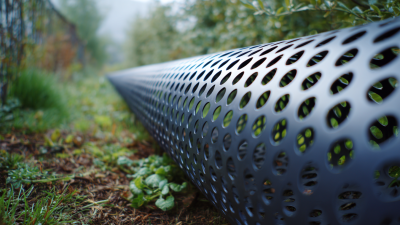
Start with the grate. Select a load class suited to the location, not merely its appearance. A pedestrian courtyard needs different protection from a loading bay or roadway. Grate openings should resist debris while allowing rapid inflow. Narrow slots look clean, but leaves can block them quickly. Keep access practical.
Outlet sizing deserves equal attention. Match the outlet capacity to calculated runoff, channel length, slope, and expected sediment. A small outlet may leave water standing after a short storm. Add inspection points where maintenance crews can remove grit without breaking surrounding paving.
End caps, connectors, silt baskets, and vertical adapters should fit securely and remain replaceable. EN 1433 and applicable local standards can guide load classification and installation.
Field experience still matters: check actual low points after rain, because drawings often miss them. I have seen elegant systems fail at one overlooked outlet.
Drainage is rarely ruined by one dramatic choice. Small mismatches cause trouble.
How to Choose the Right Drainage Channel in 2026?
Planning should begin with water movement, not appearance. Measure the catchment area, expected rainfall, ground slope, and outlet location. A channel near a driveway needs a stronger load rating than one beside a garden path. Check local drainage requirements before ordering materials. This prevents expensive changes later.
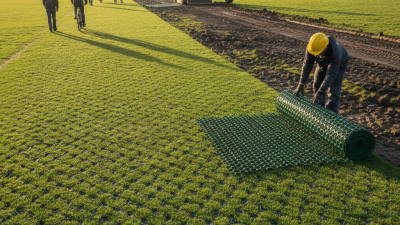
Installation quality controls long-term performance. Prepare a stable, even trench with enough depth for the channel body and concrete surround. Keep a consistent fall toward the outlet, even when the ground looks level. Seal joints carefully, and protect the channel from movement while concrete cures. I have seen excellent channels fail because installers rushed this stage. That mistake is easy to repeat. Leave access points for cleaning, especially near trees, entrances, and low corners. Maintenance should include removing leaves, sediment, and gravel before water backs up. Inspect grates for cracks after heavy vehicles or severe storms.
Tips: Choose removable grates. Photograph hidden connections before backfilling. Test the system with a bucket of water. It reveals slow flow quickly. Review the design after the first wet season; real site behavior may differ from the plan. A small correction early can protect the surrounding paving for years.
| Channel Type | Recommended Applications | Typical Internal Width | Typical Depth | Common Load Classes* | Typical Outlet Options | Installation Requirements | Maintenance Profile | Expected Service Life** |
|---|---|---|---|---|---|---|---|---|
| Polymer Concrete Linear Channel | Driveways, parking areas, commercial entrances, loading zones, and pedestrian areas | 100–300 mm | 100–300 mm | A15–D400, depending on the grate and installation design | Vertical bottom outlet, side outlet, or end outlet | Requires a stable concrete surround sized for the expected traffic load; accurate level and slope are essential | Periodic grate removal, sediment removal, and jet or vacuum cleaning when required | 25–50+ years when correctly specified and installed |
| HDPE or PP Modular Channel | Residential landscaping, patios, pedestrian paths, light-duty parking, and retrofit projects | 100–200 mm | 80–250 mm | A15–C250, subject to the product and support detail | Snap-in or bonded bottom, side, and end connections | Lightweight handling; must be fully supported and protected from deformation during backfilling | Simple access for visual inspection and manual debris removal; flush periodically | 20–40+ years, depending on UV exposure, traffic, chemicals, and installation quality |
| Cast-in-Place Concrete Trench | Heavy industrial yards, ports, agricultural facilities, large vehicle areas, and custom drainage layouts | 200–600+ mm | 200–600+ mm | C250–F900 when structurally designed for the site | Formed outlet, sump connection, catch basin, or pipe connection | Requires engineered reinforcement, joints, curing, concrete quality control, and careful formwork | Access covers or removable grates are needed for sediment and contaminant removal | 30–60+ years with suitable concrete design and joint maintenance |
| Stainless Steel Slot Drain | Indoor wet areas, commercial kitchens, food-processing spaces, hospitals, and architectural paving | 50–200 mm | 50–250 mm | Usually A15–C250; verify the tested assembly | Bottom outlet, side outlet, trapped outlet, or integrated sump | Needs accurate screed falls, compatible sealants, corrosion-resistant fixings, and hygienic joints | Frequent cleaning may be required; removable access sections simplify inspection | 20–40+ years, depending on stainless-steel grade, chemicals, temperature, and cleaning regime |
| Trench with Ductile Iron or Galvanized Grate | Road crossings, commercial vehicle routes, service yards, and areas exposed to impact or abrasion | 100–300 mm | 100–400 mm | B125–E600, depending on the complete channel-and-grate system | Vertical outlet, side outlet, end outlet, or connected catch basin | Requires strong bedding, lateral concrete support, secure grate locking, and correct finished paving levels | Inspect grate fixings and corrosion; remove sediment from the channel and connected sump | 25–50+ years, depending on corrosion conditions, traffic, and maintenance |